
Textile processing involves multiple wet treatments where fabric interaction with water, chemicals, and dyes must be carefully controlled. From pre-treatment to finishing, textile surfactants play a critical role in improving wetting, cleaning, emulsification, and uniform chemical penetration.
Among the different surfactant classes used in the industry, non-ionic surfactants are widely preferred due to their stability, compatibility, and consistent performance under demanding processing conditions. This guide explores the role of non-ionic surfactants in textile processing, key application stages, and the most commonly used types of textile surfactants.
Role of Surfactants in Textile Processing
Surfactants in textile processing act as process enablers, allowing fabrics to interact efficiently with water and chemical formulations. Their primary functions include:
- Improving the wetting of fibers
- Removing oils, waxes, and impurities
- Emulsifying and dispersing contaminants
- Enhancing penetration of dyes and finishing agents
- Ensuring uniform and reproducible processing results
Without the right surfactant system, textile processes can suffer from uneven treatment, poor dye uptake, fabric defects, and higher reprocessing costs.
Textile Wet Processing Stages and Surfactant Function
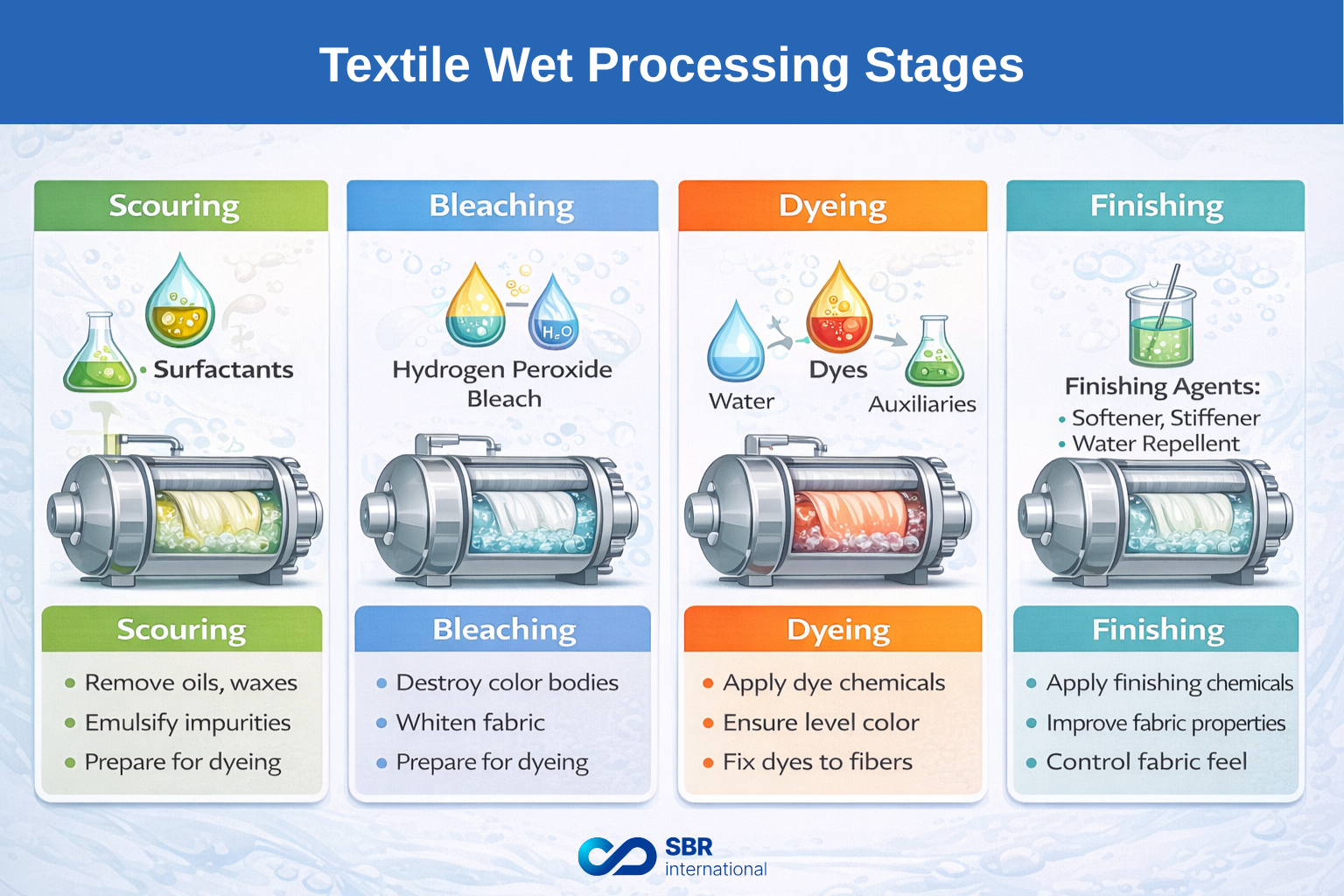
Key stages of textile wet processing—scouring, bleaching, dyeing, and finishing—are supported by surfactants.
- Scouring: Surfactants act as scouring and wetting agents to remove oils, waxes, and impurities from fibers.
- Bleaching: Wetting and stabilizing surfactants ensure uniform chemical action and fabric penetration.
- Dyeing: Surfactants support even dye dispersion, penetration, and level color development.
- Finishing: Emulsifying surfactants help apply softeners, water repellents, and functional finishes evenly.
Why Non-Ionic Surfactants Are Preferred in Textiles
Non-ionic surfactants are extensively used in textile applications because they offer several advantages over ionic surfactants:
- Stability across a wide pH range
- Low sensitivity to water hardness
- Compatibility with dyes, enzymes, and finishing chemicals
- Consistent performance at elevated temperatures
- Reduced risk of fiber damage or shade variation
These properties make non-ionic surfactants suitable for nearly every stage of textile wet processing.
Types of Textile Surfactants Used in Processing
Textile surfactants are selected based on the specific process requirement. The most common functional categories include:
- Wetting agents
- Scouring agents
- Detergents and emulsifiers
- Dispersing agents
1. Wetting Agents
Wetting agents are designed to reduce the surface tension of water, allowing it to spread quickly and uniformly over textile fibers. Fabrics—especially synthetic fibers or tightly woven materials—naturally resist water penetration. Wetting agents overcome this resistance and ensure rapid and even wet-out.
In textile processing, wetting agents are essential during:
- Desizing and pre-treatment
- Scouring and bleaching
- Dyeing and finishing
Effective wetting improves chemical penetration, reduces processing time, and ensures consistent results across the fabric surface. Non-ionic wetting agents are commonly used because they remain effective under varying pH and temperature conditions.
2. Scouring Agents
Scouring agents are used during the pre-treatment stage to remove natural and processing-related impurities such as waxes, oils, pectins, and spinning lubricants from fibers. Proper scouring is critical for achieving uniform dye uptake and clean fabric appearance.
Scouring agents work by:
- Emulsifying oils and waxes
- Suspending removed impurities in the bath
- Preventing redeposition onto the fabric
Non-ionic scouring agents are widely preferred because they perform effectively in alkaline conditions, tolerate high temperatures, and provide strong emulsification without damaging fibers.
3. Detergents and Emulsifiers
Detergents and emulsifiers are used primarily in washing and cleaning stages, including post-dyeing and finishing processes. Their role is to remove unfixed dyes, residual chemicals, oils, and processing aids from the fabric.
These surfactants help by:
- Breaking down and emulsifying oily contaminants
- Keeping impurities dispersed in the wash liquor
- Delivering effective cleaning with controlled foaming
Non-ionic detergents are especially valuable in modern textile machinery because they offer strong cleaning performance while minimizing foam formation and fabric stress.
4. Dispersing Agents
Dispersing agents ensure that insoluble particles—such as dyes, pigments, or finishing additives—remain evenly distributed in the processing bath. This is particularly important in dyeing operations where uneven dispersion can lead to streaks, spots, or shade variations.
Dispersing agents:
- Prevent particle agglomeration
- Maintain uniform suspension of solids
- Support level dyeing and consistent coloration
In textile processing, non-ionic dispersing agents are often chosen for their compatibility with dyes and stability across a wide range of operating conditions.
Functional Overlap in Textile Surfactants
In practice, many textile surfactants are multifunctional. A single non-ionic surfactant may act as a wetting agent, emulsifier, and dispersing agent depending on formulation design and processing conditions.
This overlap allows textile processors to:
- Simplify formulations
- Reduce the number of auxiliaries used
- Improve process efficiency and consistency
Selecting the right surfactant system, therefore, requires understanding both the primary function and the secondary benefits it delivers within the textile process.
Non-Ionic Wetting Agents in Textile Processing
Function and Importance
Wetting agents reduce surface tension, allowing water and processing chemicals to spread quickly and uniformly over textile fibers. Effective wetting is essential for consistent scouring, bleaching, dyeing, and finishing.
Applications
- Fabric preparation and desizing
- Pre-treatment of natural and synthetic fibers
- Improved penetration of dyes and auxiliaries
Non-ionic wetting agents are preferred because they maintain performance across varying temperatures and pH → critical for modern textile lines.
Scouring Agents for Textile Pre-Treatment
Role of Scouring Agents
Scouring removes natural impurities such as waxes, oils, pectins, and spinning lubricants from fibers. This step prepares the fabric for uniform dyeing and finishing.
Why Non-Ionic Scouring Agents Work Best
Non-ionic scouring agents:
- Emulsify oils and waxes effectively
- Prevent the redeposition of removed impurities
- Remain stable in alkaline conditions
- Perform well at high processing temperatures
They are commonly used in cotton, blended fabrics, and synthetic fiber processing.
Surfactants Used in Dyeing Operations
During dyeing, surfactants ensure controlled dye distribution and penetration while preventing issues such as streaking or uneven shades.
Key Functions
- Improve dye solubility and dispersion
- Control dye migration
- Support level dyeing
Non-ionic surfactants are particularly effective because they do not interfere with ionic dyes and maintain stability throughout the dye bath.
Detergents and Emulsifiers in Textile Washing
Post-dyeing and finishing processes require efficient washing to remove unfixed dyes, oils, and chemical residues.
Benefits of Non-Ionic Detergents
- Strong detergency without fiber damage
- Effective emulsification of oils
- Low foaming options for high-speed machinery
These surfactants ensure clean fabrics while reducing water and energy consumption.
Compatibility Across Textile Fibers
Non-ionic surfactants are used across a wide range of fibers, including:
- Cotton and cellulosic fibers
- Polyester and synthetic fibers
- Blended fabrics
Their versatility allows textile processors to standardize formulations across multiple fabric types.
Environmental and Process Efficiency Considerations
Modern textile processing places strong emphasis on sustainability and efficiency. Non-ionic surfactants support this by:
- Offering good biodegradability profiles
- Reducing chemical and water usage
- Supporting lower reprocessing rates
- Improving overall process efficiency
Choosing the right textile surfactant contributes directly to cost optimization and regulatory compliance.
Selecting the Right Surfactant for Textile Applications
When choosing surfactants for textile processing, manufacturers should consider:
- Fabric type and fiber composition
- Processing stage (scouring, dyeing, washing, finishing)
- Temperature and pH conditions
- Compatibility with other auxiliaries
- Environmental and regulatory requirements
A formulation-driven selection approach ensures consistent results and long-term operational efficiency.
Textile Surfactant Solutions from SBR International
At SBR International, we supply high-performance non-ionic surfactants designed for a wide range of textile processing applications. Our portfolio supports scouring, wetting, washing, dyeing, and finishing operations across natural and synthetic fibers.
Backed by technical expertise, regulatory documentation, and flexible global logistics options, SBR International partners with textile manufacturers to optimize processing efficiency, product quality, and supply reliability.
For tailored recommendations on surfactants used in textile processing, our team is available to support your formulation and sourcing needs.