


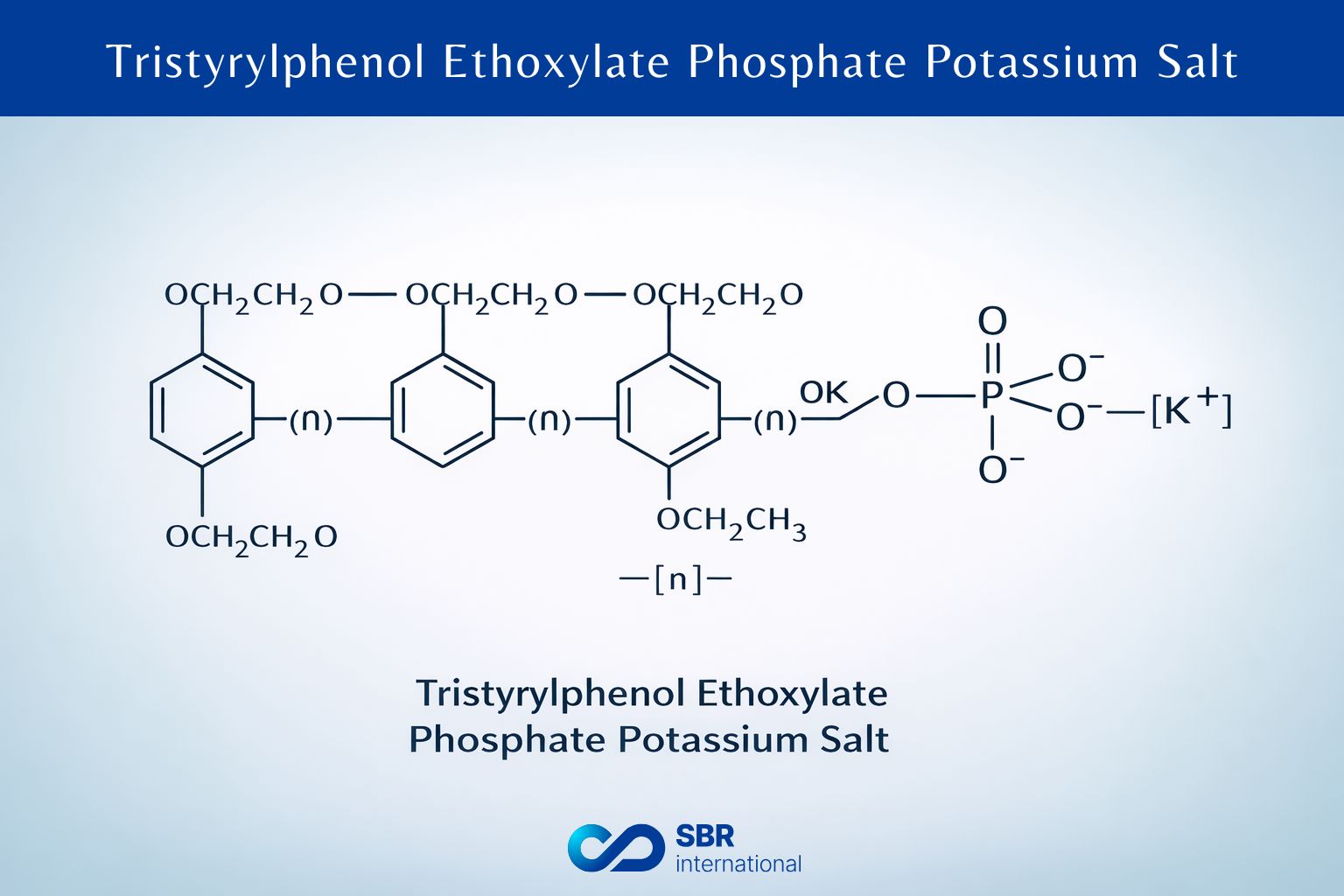
Tristyryl Phenol Ethoxylate Phosphate Potassium Salt (50–60%) is a phosphate ester–based surfactant widely used as a dispersing and wetting agent in agrochemical, coating, and specialty chemical formulations. Its structure allows effective interaction with both hydrophobic and hydrophilic components, making it suitable for systems that require stable dispersion and consistent performance.
In technical literature and formulation documentation, this compound is also commonly referred to as tristyrylphenol ethoxylate, reflecting standardized chemical naming conventions used across datasheets and regulatory references. Both terms are used interchangeably within the industry to describe the same underlying chemical structure.
Technical Identification and Classification
Tristyryl Phenol Ethoxylate Phosphate Potassium Salt belongs to the class of phosphate ester surfactants. It is typically supplied as an aqueous potassium salt and is valued for its ability to stabilize suspensions and improve wetting across diverse formulation environments.
Within formulation work and regulatory documentation, this material may be listed under several naming variants, including tristyrylphenol ethoxylate phosphate ester and potassium salt derivatives. These references point to the same functional chemistry, with naming variations driven by documentation standards rather than structural differences.
What Is Tristyryl Phenol Ethoxylate Phosphate Potassium Salt?
Tristyryl Phenol Ethoxylate Phosphate Potassium Salt is a specialty chemical used primarily as a dispersant and wetting agent. It supports the uniform distribution of active ingredients and enhances formulation stability in systems where particle suspension and surface interaction are critical.
Its phosphate ester functionality contributes to strong affinity for solid particles, while the ethoxylated aromatic backbone improves compatibility within complex formulation matrices.
Key Functional Properties
Effective dispersion of solid actives
Improved wetting of hydrophobic surfaces
Compatibility with a wide range of formulation systems
Stability in aqueous environments
Support for suspension concentrate formulations
These properties make it suitable for use in formulations that require controlled particle distribution and long-term stability.
Applications in Specialty Formulations
Agrochemical Formulations
In agrochemical systems, this phosphate ester surfactant is commonly evaluated during formulation screening and technical validation. It supports the dispersion of active ingredients in suspension concentrates and enhances surface coverage during application.
Coatings and Industrial Formulations
In coatings and industrial chemical systems, the compound contributes to pigment dispersion and improved wetting, supporting uniform film formation and consistent performance.
Specialty Chemical Systems
Its balanced hydrophilic and lipophilic characteristics allow it to function effectively in specialty formulations where stability and compatibility are essential.
Technical Data Sheet Reference Information
Formulators and procurement teams frequently assess Tristyryl Phenol Ethoxylate Phosphate Potassium Salt through technical data sheets to evaluate parameters such as solubility, dispersion efficiency, compatibility, and application suitability.
While specific values may vary by grade and formulation, this compound is typically selected based on its proven performance in stabilizing complex systems and supporting formulation reliability.
Industry and Regulatory Context
As formulation requirements evolve toward greater consistency, efficiency, and regulatory alignment, phosphate ester–based dispersants continue to play a role in technical formulation development. Accurate documentation and standardized chemical identification remain essential for regulatory evaluation and global market use.
Role of SBR International GmbH
Within this technical landscape, companies such as SBR International GmbH support formulators by supplying specialty chemical solutions aligned with performance, quality, and regulatory expectations. By focusing on formulation compatibility and technical reliability, SBR International contributes to the effective application of phosphate ester–based dispersants across industrial and agrochemical sectors.
Summary Table
The following summary provides a high-level technical overview commonly referenced during formulation evaluation and documentation.
Property | Detail |
Product Type | Dispersing and Wetting Agent |
Composition | Tristyryl Phenol Ethoxy Phosphate (50-60%) Tea Salt |
Main Applications | Agrochemicals, Paints, Cosmetics |
Key Features | High solubility, excellent suspension and dispersion properties |
Key Benefits | Improves active ingredient efficiency, enhances formulation stability, optimizes absorption, and reduces costs |
Compatibility | Compatible with a wide range of chemicals |
Conclusion
Tristyryl Phenol Ethoxylate Phosphate Potassium Salt (50–60%) serves as a functional dispersing and wetting agent within agrochemical, coating, and specialty chemical formulations. Its phosphate ester structure and ethoxylated backbone support stable dispersion and reliable performance across diverse systems.
Understanding its classification, technical role, and naming conventions helps formulators and procurement professionals evaluate its suitability within formulation design and regulatory frameworks.